Last updated: 27 July 2026 · based on 56 courses publishing rates
Thailand is one of the world's great golf destinations — championship courses at a fraction of European or Australian green fees, world-class caddies, and a country that knows how to look after visitors. But the golf works differently here, and the costs are not where first-timers expect them. This guide covers what a trip actually costs, when to go, where to base yourself and the practicalities nobody mentions until you are standing on the first tee.
Everything below is built on the published rates we hold for the courses in our directory, plus current operator pricing and official sources, all checked in July 2026.
Two minutes to fill in, and we come back with actual quotes from courses and Thailand golf specialists. Free, and no obligation.
Green fees are the headline, and they are genuinely cheap. Across the 56 courses in our directory publishing visitor rates, the average is ฿2,342 in low season and ฿3,260 in high season. What catches people out is everything stacked on top.
Caddie fees are compulsory and separate. Thailand runs a caddie system at effectively every course — it is not optional and not included in the green fee. Expect ฿350–500 per round: Black Mountain publishes ฿350, Chiangmai Highlands ฿400 and Siam Country Club ฿500.
Then the tip, which is the caddie's real income. Siam Country Club's own guidance says gratuities "generally start at THB 500"; Chiangmai Highlands suggests "400 THB and upwards". Pay it in cash, directly to your caddie, at the end of the round. Every golf package we examined excludes it.
Carts, and a trap for pairs. Carts run ฿700–1,000. At premium clubs including Siam Country Club and Black Mountain, carts are mandatory at one per golfer, driven by the caddie — so two golfers pay for two carts, not one shared buggy.
A genuinely useful quirk: booking agents sometimes undercut the club's own desk. Siam Country Club's Old Course lists ฿6,500 weekday green fee only, while agent rates for the same course have been published around ฿6,100 including caddie and cart. Always compare the club's rate against an agent before walking up.
Our trip cost calculator itemises all of this for your own group, and the Green Fee Index shows how regions compare on price.
Send us the rough shape of it and we will come back with real numbers — including the bits operators leave out.
Dry, cooler mornings, and the season Thai courses are conditioned for. March extends it in most regions.
Not July — despite what the “low season” advice says. See below.
Chiang Mai and the north only — agricultural burning season. The south is fine.
Region-by-region detail is in our guide to the best time to play.
| Region | Best for | Watch out for |
|---|---|---|
| Pattaya | Most courses within 45 minutes; strongest value; easiest for societies and groups | The town divides opinion — Jomtien or Na Jomtien are quieter bases |
| Hua Hin | Quality per baht, relaxed seaside town, the shortest wet season of the golf regions | Fewer courses than Pattaya; 3–4 hours from Bangkok |
| Bangkok | The prestige clubs and tournament venues; good for short stopovers | Traffic — an hour each way is normal, so stay near your courses |
| Phuket | Combining golf with a beach holiday; strong resort courses | Highest costs; wettest weather May–October |
| Chiang Mai | Cool-season mountain golf and the best all-round non-golf offering | Burning season March–April — avoid |
| Khao Yai | Cooler air, national-park scenery, an easy two hours from Bangkok | Fewer courses; better as an add-on than a whole trip |
Undecided? The course comparison tool lets you filter every course in Thailand by price, length, prestige and the kind of trip you are planning.


Or simply rent. Almost every Thai course rents clubs — ฿1,500 at Black Mountain, ฿2,500 at Siam Country Club. For a trip with two or three rounds, renting often beats paying sports-equipment fees both ways.
On the ground: a metered taxi from Suvarnabhumi into central Bangkok runs about ฿300–500 including the airport surcharge and tolls. Grab and Bolt will usually take golf bags but it is not guaranteed — there is no golf-bag filter in the app, small cars cannot fit a full set, and regulations permit a surcharge of up to ฿100 per item. For a dawn tee time, pre-book a private transfer. Direct airport coaches to Pattaya start around ฿130 and to Hua Hin around ฿342, but check the baggage limit: the standard allowance of one bag up to 20kg can be tight with clubs.
At the time of writing, most Western tourists — including UK passport holders — enter Thailand under a 60-day visa exemption, extendable by a further 30 days, per UK FCDO guidance. The Thai cabinet approved cutting this to 30 days for 59 countries and territories, with updated details agreed in July 2026, but the measures were still pending publication in the Royal Gazette and take effect 15 days after it. Until then current conditions apply. For a two-week golf trip this makes no practical difference, but confirm the position before you book.
Everyone needs the Thailand Digital Arrival Card. Since 1 May 2025 all foreign nationals must complete it online before arrival, replacing the old paper form. Submit within 72 hours of travel, complete a new one for every entry, and keep the confirmation on your phone. Use the official government portal — plenty of paid look-alike sites exist.
Your passport must be valid for six months beyond arrival with at least one blank page.
Take proper travel insurance. The FCDO notes that all Thai hospitals require a guarantee of payment before treating patients, and advises cover for local treatment and medical evacuation. Check vaccination guidance at least eight weeks before travel. One golf-specific tip: standard policies often cap or exclude sports equipment, so check whether your clubs need declaring separately.
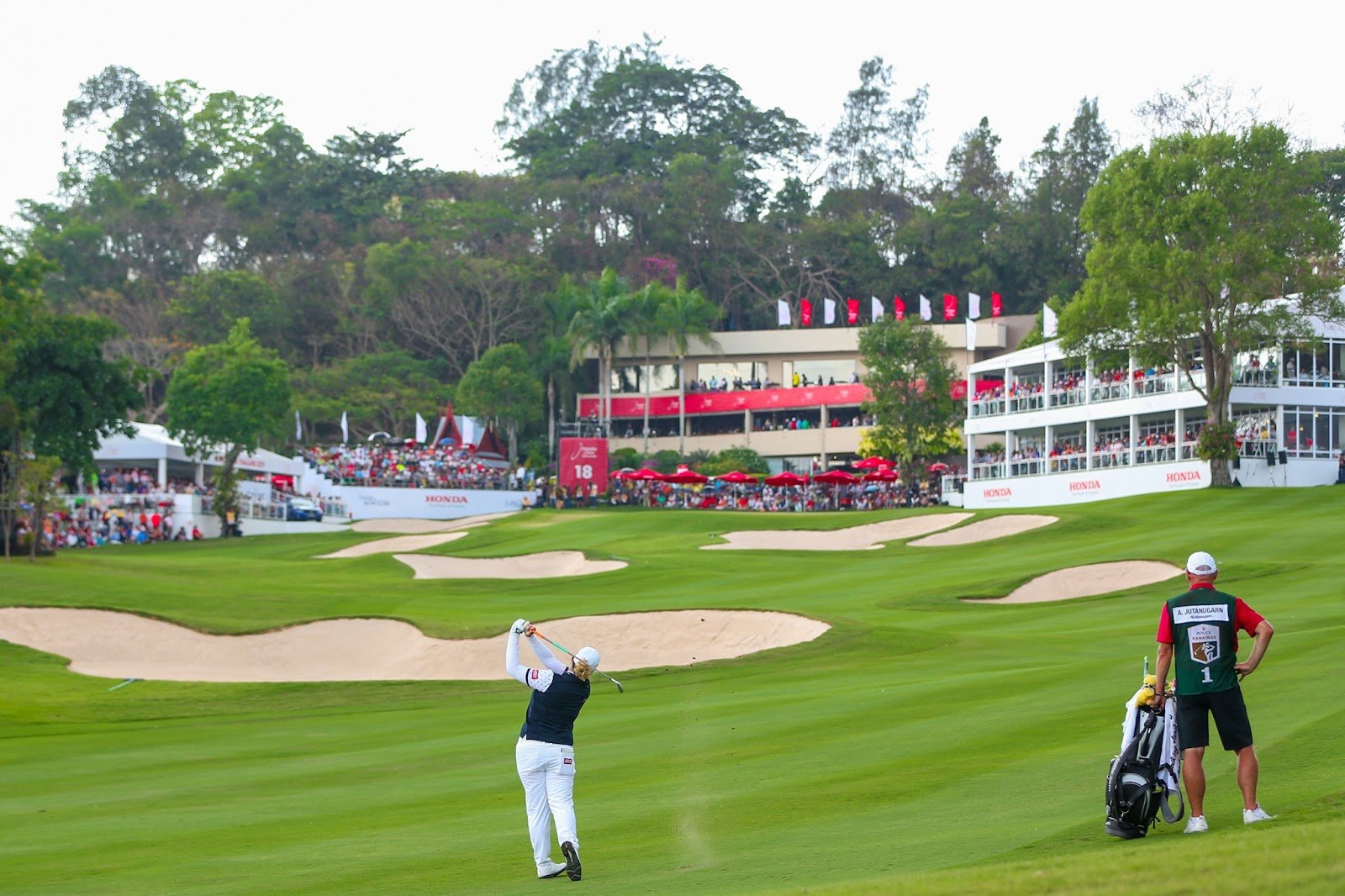
Honda LPGA Thailand is the biggest week in Thai golf, played at Siam Country Club's Old Course in Pattaya. The 2026 edition ran 19–22 February and was won by Jeeno Thitikul at 24-under on home soil. Spectator access is straightforward and it makes an excellent centrepiece for a February trip.
The Centara World Masters is the one to know about if you would rather play than watch — an amateur tournament for club golfers with age and handicap divisions, drawing around 400 players from 30 countries. The 2027 edition runs 6–12 June 2027 in Hua Hin at Black Mountain and Pineapple Valley (the rebranded Banyan). Packages run ฿44,500–89,900 per golfer and registration closes 31 August 2026.
Tell us what you're planning and we'll come back with quotes from courses and Thailand golf specialists. Free, no obligation.
Excluding flights, budget roughly £1,100–£1,900 per golfer for seven nights with five rounds at a four-star hotel. Green fees across the 56 courses in our directory that publish rates average ฿2,342 in low season and ฿3,260 in high season, and you must add a compulsory caddie fee of around ฿371 plus a customary tip of ฿400–500 per round.
November to February gives the most reliable weather nationwide. If you are flying from Europe, note that July is a peak-price month because of school holidays rather than Thai weather — May, June and September are usually the cheapest times to fly. Avoid Chiang Mai in March and April, when agricultural burning causes severe air pollution.
Most Western tourists currently enter under a 60-day visa exemption. The Thai cabinet approved reducing this to 30 days for most countries in 2026, but at the time of writing the change had not yet taken effect. Separately, everyone must complete the Thailand Digital Arrival Card online within 72 hours before arriving. Always check current rules before booking.
Yes, at effectively every course. The caddie fee is charged separately from the green fee, and a cash tip of ฿400–500 per round is expected on top — no golf package we have seen includes it. At premium clubs such as Siam Country Club and Black Mountain each golfer takes their own cart, driven by the caddie, which doubles the cart cost pairs might expect.
Four or five rounds over seven nights suits most golfers. Thai rounds take four and a half to five and a half hours in heat and humidity, so daily golf is more tiring than at home. Groups that plan seven rounds in seven days routinely drop one.